Table of Content
Focus on what matters. BIXO handles the rest!

It can be overwhelming when you are managing a project and trying to track costs, timelines and progress. Earned value management provides you with an easy method of seeing exactly where your project stands and spotting issues before they arise. Through this approach, you will be able to make wiser decisions and keep your project on track.
You’ll get a clear idea of what earned value management is, how it works in real projects, and why it matters. You’ll also see simple steps to use it and examples that make everything easier to understand.
What Is Earned Value Management?
Earned value management is a technique that helps you compare your planned work with the work you have actually completed so that you can be able to see the true status of your project. Simple earned value analysis gives you one clear view of cost, time and progress, and lets you see what you have accomplished, and what you still need to give attention to. With simple earned value management tools, you can track actual performance rather than guessing, which will help you stay clear as to where your project stands.
Why Earned Value Management is Important?
Here’s a quick look at why earned value management is important for understanding how your project is actually progressing.
Shows the Real Health of the Project
Earned value management brings your planned work and actual work into one clear picture. You can quickly see how much work has been done and whether the project is moving as expected. This helps you understand the real status of the project without relying on guesses or assumptions and gives you a solid base to guide your next steps.
Helps Spot Problems Early
With simple EVM measures, it becomes easier to observe unexpected issues as you track cost and schedule performance. Any early indications of delays or extra expenditure are quickly noticed. This provides you with sufficient time to correct issues before they grow and keeps the project steady and under control.
Improves Decision Making
Better information leads to better choices. Earned value management provides you with clear figures on what is done, what value is earned, and what still needs attention. Now with this understanding, you are better able to make adjustments and spend resources wisely, as well as respond to any changes with confidence.
Makes Forecasting More Accurate
When you use actual performance data as opposed to estimates, future results can be more easily predicted. By tracking progress and performance trends, you get realistic expectations and can plan the next steps more effectively, preparing you to take action for the future.
Strengthens Accountability and Transparency
When everyone can see and measure progress, it’s easier to understand how the project is going. Earned value management contrasts planned and actual progress, making it easier to track individual responsibilities. This openness creates better communication, makes it clear what is required of everyone, and keeps the team on the same track and goal-oriented.
What Are the Key Components of Earned Value Management (EVM)?
To use EVM effectively, you first need to understand its main components. These elements help you measure progress, compare what you planned with what actually happened, and see how smoothly your project is moving. Here’s a simple breakdown of each one.
Planned Value (PV)
Planned value refers to the amount of work that you expect to have accomplished by a certain time in your project. It is what you are aiming to reach before the working process starts. PV shows whether your actual progress matches what you planned for in terms of time and budget. When you apply it in the name of earned value management, you can soon realise whether the project is progressing the way you anticipated or going off track.
Earned Value (EV)
The earned value shows the value of the work that you have actually done. It informs you of the real progress you have achieved, rather than the amount of time or money you have spent. EV is the heart of earned value management as it reflects actual outcomes. When comparing EV to your plan, it becomes clear immediately whether your project is ahead, behind, or on track.
Actual Cost (AC)
Actual cost tells you the amount of money you have actually spent on the work completed so far. The significance of AC lies in the fact that the comparison between AC and EV will show whether the project is costing more or less than expected. It keeps you aware of spending in order to prevent unwanted surprises.
Cost Variance (CV)
Cost variance is the difference between the value of the work completed (EV) and the actual money spent (AC). When the CV is positive, you are spending less than planned. If it is negative, you are overspending. CV provides you with a clear indication of how well you're controlling project costs, and assists you in fixing the problems at an early stage.
Schedule Variance (SV)
Schedule variance is used to compare the work you've completed (EV) against the work you planned to finish by now (PV). A positive SV means you are ahead of schedule, and a negative SV means you are behind. SV helps you understand whether your timeline is on track and where you may need to adjust to prevent delays.
How to Implement Earned Value Management?
Implementing earned value management is much simpler when you follow a clear process. You set a solid foundation, track real progress, and rely on accurate numbers to understand how your project is doing. Here’s how you can apply EVM in a practical, easy-to-manage way.
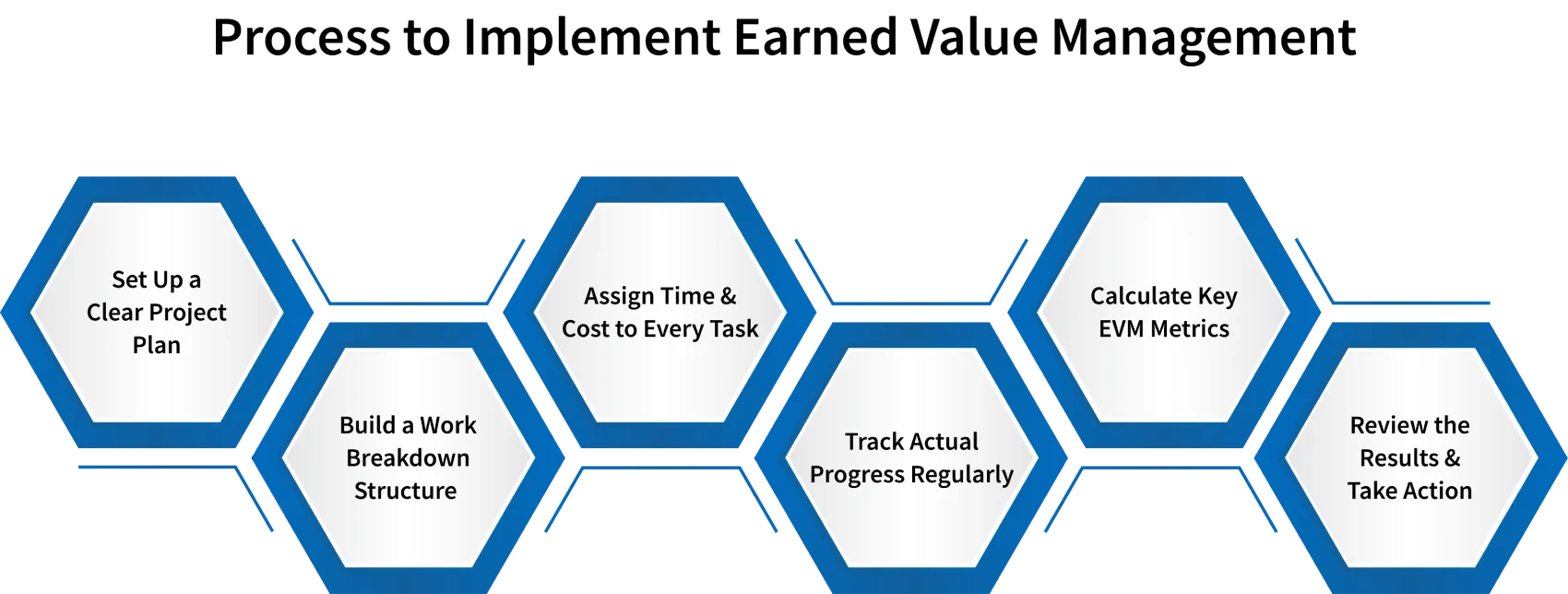
Set Up a Clear Project Plan
You must have a good project plan before you start using earned value management. This means establishing your scope, dividing the work into small tasks, and mapping your schedule. This helps you understand what earned value is, because now you know because know exactly what you are measuring. A clear plan becomes the base for the earned value analysis in project management, so you always know the status of things.
Build a Work Breakdown Structure
Prepare a work breakdown structure that shows all tasks that your project needs. You can divide the work in a detailed manner, and then it becomes easier to apply the earned value management techniques later. You can assign a budget and timeline to each task, giving you a solid structure to manage earned value in a consistent way. This also renders your tracking more accurate and less stressful.
Assign Time and Cost to Every Task
When you have your tasks listed, you need to assign each one a planned cost and a planned start date and a planned finish date. These numbers become your reference point. The absence of such a reference point will not allow you to calculate planned value or determine how to use EVM effectively. When every task has a cost and schedule, you get a realistic picture of what progress should look like as the project moves forward.
Track Actual Progress Regularly
Periodically update your actual work and actual costs. This is when earned value analysis starts helping you make better decisions. By comparing your planned value with the earned value and the actual cost, you can have a clear picture of the project's performance. You can also spot differences early, which will help you stay in control rather than respond too late. In simple terms, frequent tracking keeps your figures accurate.
Calculate Key EVM Metrics
And now, it is time to calculate the numbers. If you want to calculate EVM, you start with three core numbers called planned value, earned value and actual cost. Once you have these, you can calculate cost variance, schedule variance, and performance indexes. These metrics show whether your project is ahead, behind, or spending more than expected. You get real insights instead of guesswork, and that is the real advantage of value management in project management.
Review the Results and Take Action
Once you have your numbers, the next step is to understand what they mean. Look at your variances and trends and determine what to address. Earned value management makes this easier because you can see exactly what’s happening instead of guessing. You leverage data to change timelines, reassign resources, or address risks before they escalate. It is your way of keeping things on track and moving in the right direction using EVM.
What Are the Examples of Earned Value Analysis?
Earned Value Analysis (EVA) helps you understand how much work is actually done compared to what was planned, and whether the project is staying on budget or not. Here are some real-life examples of EVA explained simply:

Manufacturing Project: Output vs Planned Production
A factory aims to produce 1,000 units in a set timeframe. But it only produced 800 units.
Through earned value analysis, managers can understand:
- Why was the target not reached?
- Are delays due to machine downtime, labour issues, or supply shortages?
- What changes are needed to improve production speed?
This helps increase efficiency and prevent future delays.
Forecasting Final Cost Using EAC
Even if a project is going smoothly in terms of progress, sometimes the cost starts increasing faster than planned.
For example:
- The planned budget for the full project is $12,000.
- But based on current spending, the project may end up costing $15,600.
With earned value analysis and formulas like Estimate at Completion (EAC), you can estimate the final cost before the project ends. This helps you:
- Arrange extra budget in advance.
- Reduce unnecessary expenses.
- Adjust scope to control spending.
This keeps the project financially stable and prevents budget issues later.
Software Development Project
A tech company is building a new app with a budget of $100,000 and a timeline of 6 months.
Here is what things look like at the 3-month stage:
- Planned Value (PV): By now, the project should be 50% complete.
50% of $100,000 = $50,000
- Actual Cost (AC): The team has spent $70,000.
- Earned Value (EV):: Only 40% of the work is complete.
40% of $100,000 = $40,000
Analysis:
- Schedule Variance (SV):
EV - PV = $40,000 - $50,000 = - $10,000
This means the project is behind schedule because less work has been done than planned.
- Cost Variance (CV):
EV - AC = $40,000 - $70,000 = - $30,000
This means the project is over budget because more money was spent on less work.
The project is both behind schedule and over budget, so the manager needs to identify the reasons (delays, extra resources, poor estimates, etc.) and take corrective action.
What Are the Benefits of Earned Value Management?
Earned value management helps you understand how well your project is performing by comparing the work planned with the work actually completed. It gives a clear picture of whether you are on track, behind schedule, or over budget.
Here are the key benefits:
Measures Performance Clearly
EVM tracks work using real numbers, making it easier to see how the project is actually progressing. Instead of relying on assumptions, you can use earned value analysis to check cost and schedule performance with accurate data.
Helps Spot Problems Early
Earned value management helps you spot delays or extra costs early in the project. When you see that the work is not going as planned, you can fix the issue before it becomes a bigger problem. This helps save time, reduce risks, and keep the project on track.
More Accurate Forecasting
With the data, such as planned value, actual cost, and earned value, it is possible to predict final cost and the timelines more accurately. When metrics such as Estimate at Completion (EAC) are used, it becomes easier to plan in advance and remain on track.
Improves Communication and Accountability
EVM gives a common way to report progress across teams and stakeholders. When everyone can see performance clearly, it becomes easier to share updates, explain results, and maintain accountability in earned value project management.
Supports Better Decision Making
Since EVM connects scope, cost, and schedule, it offers a full picture of the project. This makes decision-making faster and more reliable, especially in areas like resource planning, risk control, and cost management. These insights show the real advantages of value management in projects.
How BIXO Improves Accuracy in Earned Value Management?
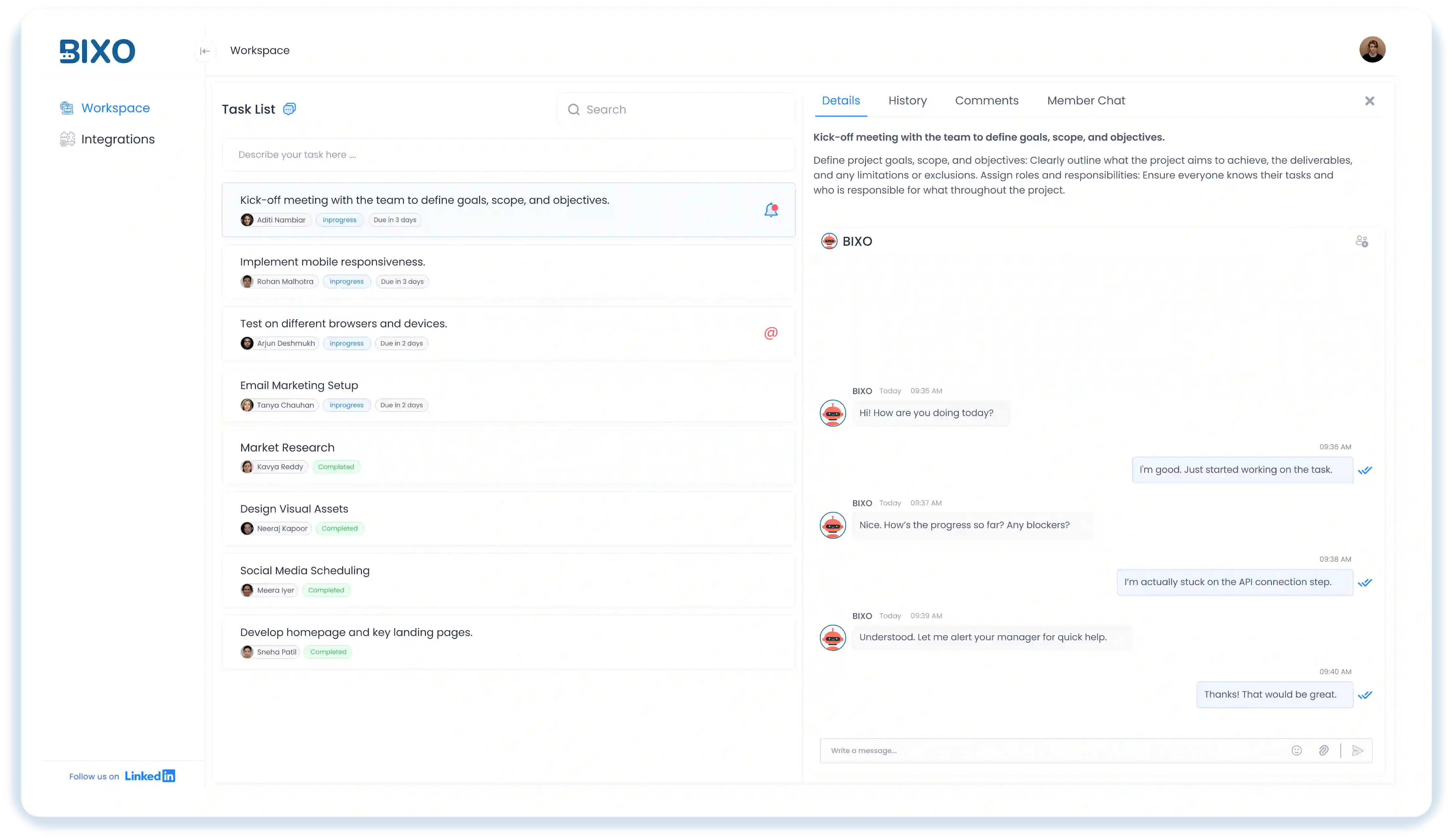
BIXO makes earned value management much more accurate by automatically following up your team’s work. It gathers updates on tasks, deadlines, and completed work in real time, so you always have a clear picture of where your project stands. This ensures your earned value analysis in project management reflects actual progress, not guesses or delayed updates. You don’t have to spend time constantly checking in with team members to get updates on their tasks and deadlines. Your earned value project management data stays consistent, reliable, and ready for calculating key EVM metrics like EV, PV, and AC.
By taking care of routine follow-ups and reminders, BIXO lets you focus on planning and making decisions instead of spending time on daily monitoring. It keeps deadlines on track, highlights risks early, and improves team accountability. Whether you’re managing a small group or a large project, BIXO adapts easily, giving you real-time insights and accurate data for how to use EVM effectively.
Conclusion
Earned value management gives you a clear picture of where your project stands by bringing together cost, schedule, and progress in one view. Using earned value management techniques and earned value analysis in project management helps you track project performance, spot issues early, and make smarter decisions. Knowing how to calculate EVM and applying value management in project management keeps your projects on track, ensures resources are used wisely, and makes outcomes more predictable, turning earned value project management into a reliable way to manage and improve project success.
FAQs
Key EVM formulas include Planned Value (PV), Earned Value (EV), Actual Cost (AC), Cost Variance (CV), Schedule Variance (SV), Cost Performance Index (CPI), Schedule Performance Index (SPI), and Estimate at Completion (EAC). They help you track project progress, spot issues, and predict results more accurately.
Some of the top EVM software are Microsoft Project, Primavera P6, Smartsheet, Wrike, Monday.com, and BIXO. These tools make tracking projects easier, give real-time insights into earned value, and help you manage costs, schedules, and performance effectively.
Yes, small teams can use EVM effectively. By tracking planned versus actual work, costs, and schedules, even with limited resources, teams can spot issues early, make smarter decisions, and keep projects on track without needing complicated tools.
EVM boosts project accuracy by bringing together cost, schedule, and work progress in a single view. It highlights differences, forecasts future performance, and helps make timely adjustments, keeping projects on track, within budget, and aligned with goals.
Get a demo of BIXO

Recommended Blogs
How to Delegate Tasks Effectively: 7 Tips for Managers
Learn how to delegate tasks effectively, save time, and boost team productivity with step-by-step tips, real examples, and smart AI tools.
 Bhuvana Bitra |
 Oct 17, 2025

Project Objectives: A Simple Guide with Real Life Examples
Learn how to set clear project objectives that guide your team, track progress, and ensure success. Get practical tips and real-life examples to get started right.
Tarun Kumar Reddy Atmakuru |
Oct 17, 2025
25 Key Project Management Skills Every Manager Should Master
Learn 25 essential project management skills - soft, hard, and technical to manage teams, meet deadlines, and deliver successful projects.
Tarun Kumar Reddy Atmakuru |
Oct 17, 2025
×
Focus on what matters. BIXO handles the rest!