Table of Content
Focus on what matters. BIXO handles the rest!

When you rely on guesswork in a project, things can quickly go wrong. Schedules go off track, the work becomes unclear, and the budget begins to move out of control. It becomes even more difficult to manage projects when estimates are not clear. Even minor problems tend to multiply when the foundation isn’t strong.
But don’t worry! Using the right project estimation techniques changes everything. They eliminate confusion and give you an accurate understanding of the time, effort, and cost involved before you begin. This blog will reveal to you six major strategies that will guide you in estimating the projects accurately. You will also know when to apply each of them so that you can choose the approach that will suit your upcoming project.
What Are the 6 Types of Project Estimation Techniques?
Estimating a project correctly is key to staying on schedule, controlling costs, and avoiding surprises. Different projects and teams require different approaches, and using the right method can save time while keeping your planning accurate. Here are the six types of project estimation techniques you must know.
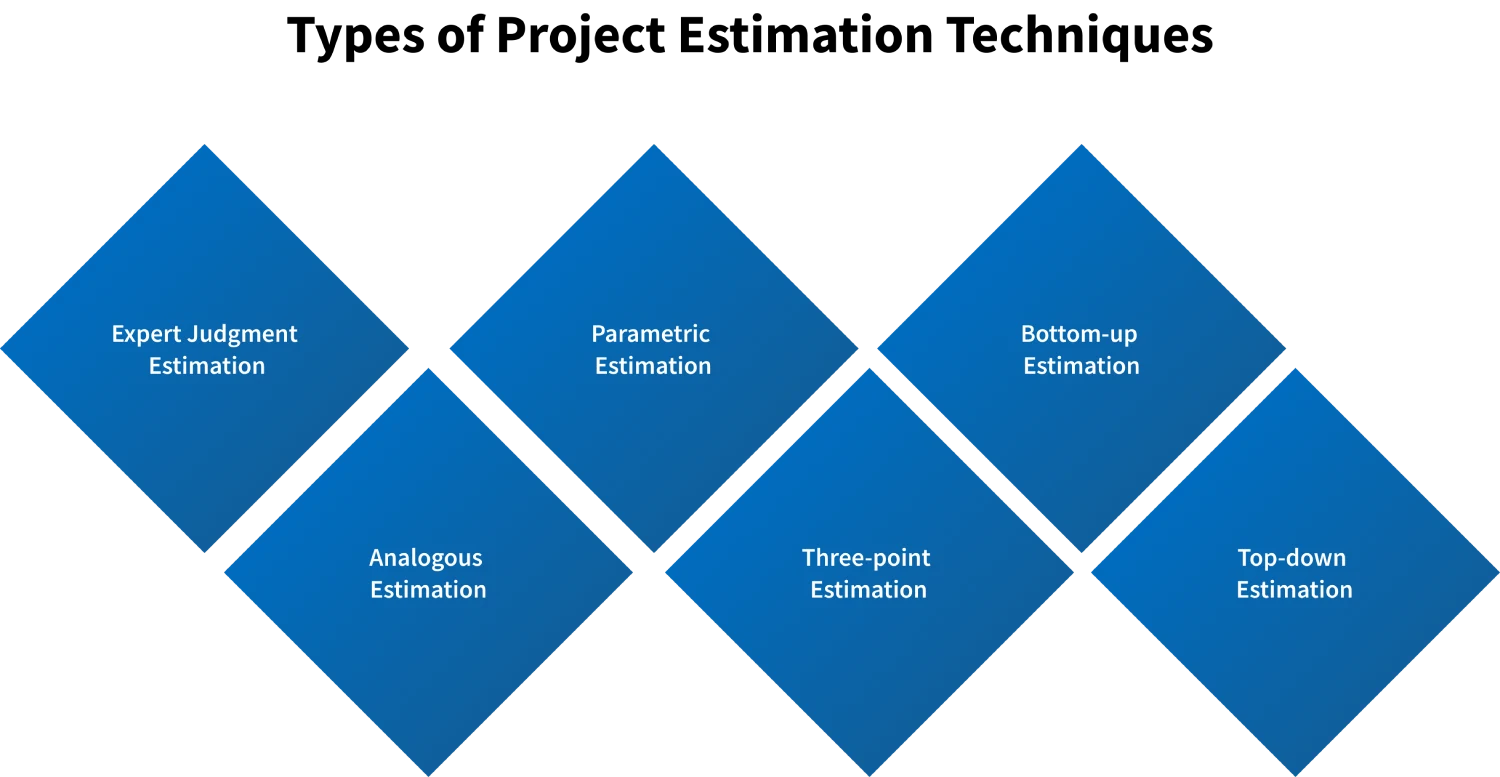
1. Expert Judgment Estimation
Expert judgment estimation relies on the experience of individuals who have handled similar projects before. You get advice on what to expect from the kind of work, complexity, and common pitfalls. By discussing the scope and requirements with experts, you form a realistic estimate of time, effort, and cost. This technique works well in contexts where there is little historical data, and you need guidance quickly. You can refine these estimates as the project progresses, which makes planning more trustworthy.
2. Analogous Estimation
Analogous estimation lets you compare your project to similar projects you've done before. You use the actual outcomes from past projects as a reference. For example, if a previous project of similar size took six weeks, you can start with that as a baseline. This technique is time-saving since you do not need to break down every task. It works best when your project closely matches prior projects, giving you a quick, high-level view of the timelines and costs.
3. Parametric Estimation
Parametric estimation uses numbers and formulas to estimate effort, time, or cost. You can select the measurable variables, e.g. lines of code, number of features, or units of work, and multiply them by a productivity rate or cost factor. An example is when it takes two days to develop one feature, and you have 20 features, you can create an estimate of 40 days of work. This method is precise when the data is trustworthy and has clear metrics.
4. Three-point Estimation
Three-point estimation takes uncertainty into account as it involves three numbers in estimating each task into optimistic, most likely and pessimistic estimates. You calculate the expected estimate through a formula, which is usually the weighted average.
Formula:
(Optimistic + 4 × Most Likely + Pessimistic) / 6
This method provides a realistic estimate that accounts for risks and uncertainties. You plan for both best-case and worst-case situations, which makes your timelines and budgets more flexible and dependable.
5. Bottom-up Estimation
The bottom-up estimation separates the project into smaller tasks and estimates them individually. You then add up all these smaller estimates to get the total. By examining each task closely, you reduce the risk of missing work or underestimating complexity.
It is a time-consuming, yet highly accurate method. It also aids you in determining dependencies, allocating responsibilities and tracking progress in a better way. You can adjust your plan in case some of your tasks take longer than expected.
6. Top-down Estimation
Top-down estimation begins with the project estimate and then moves downward. It starts with estimating the total effort, cost, or duration for the project and then divides it into smaller parts. This method is beneficial when you require a quick, high-level estimate before diving into detailed planning.
It is a time-saving method when compared to estimating each task individually. These estimates can be updated as you get more information, making project planning realistic and manageable.
How BIXO Can Make Project Estimation and Management Smarter
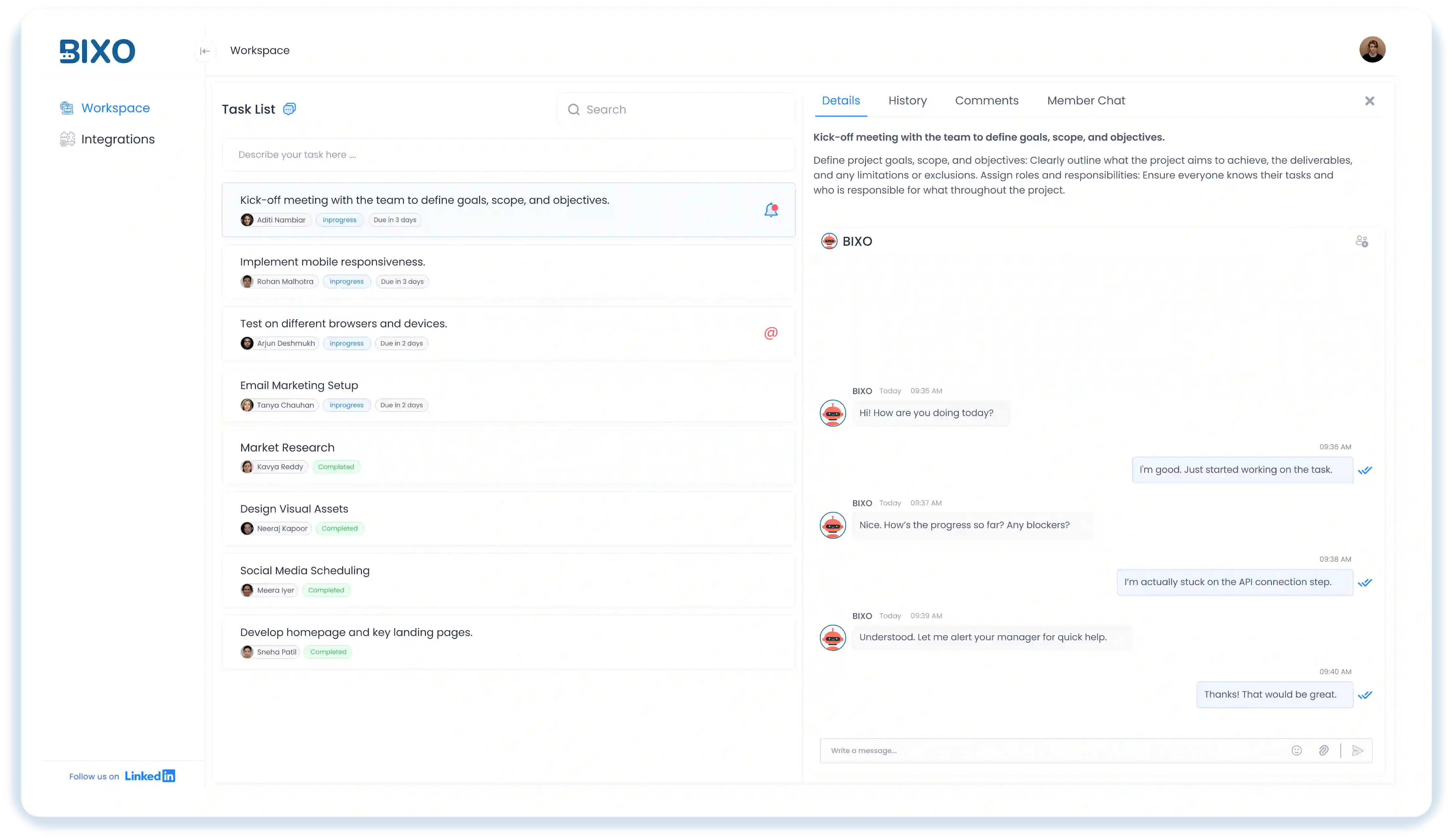
Managing projects often means spending more time chasing updates than actually getting work done. Deadlines start slipping, dependencies build up, and you keep worrying about whether everything is on track. BIXO changes that. Once you set your tasks, BIXO checks in with your team, tracks progress, and gives you clear summaries automatically.
You don’t have to spend hours asking for status updates or holding stand-up meetings. BIXO takes care of follow-ups, flags delays, and keeps you informed in real time, helping your project estimates stay realistic and manageable, even with large or remote teams. With BIXO, you can shift your focus to planning and decision-making instead of micromanaging.
It monitors work across all teams, escalates blockers intelligently, and alerts you immediately when something needs attention. You can handle hundreds of tasks or employees at once while keeping timelines, effort, and cost projections accurate. By removing the burden of manual tracking, BIXO improves productivity, supports work-life balance, and helps you deliver projects quickly, all without needing extra staff or constant oversight.
Conclusion
Project estimation feels a lot simpler when you use the right methods and know exactly how much time, effort, and money the work will take. You move away from guesswork and start planning with real clarity. Project estimation techniques give you a different way to shape your timeline, so picking the one that suits your situation keeps things steady. When your estimates stay realistic, the project runs with more confidence, fewer surprises, and an easier way to reach the final result.
FAQs
If you’re new to project estimation, start with expert judgment or analogous estimation. They rely on past experience or similar projects, giving you a quick, practical estimate without diving into complex calculations.
Choose based on your project’s data and detail level. Use parametric or bottom-up for precise, task-level estimates, and top-down or analogous when you need quick, high-level estimates before detailed planning.
Yes. Project estimates change over time. As tasks progress and new information appears, you need to update your estimates. Techniques like Three-point or Bottom-up allow you to adjust timelines, effort, and cost for more accuracy.
Avoid relying only on guesswork, ignoring task complexity, or skipping detailed breakdowns. Always consider risks, use historical data when possible, and choose the estimation technique that fits your project’s size and available information.
Get a demo of BIXO

Recommended Blogs
How to Delegate Tasks Effectively: 7 Tips for Managers
Learn how to delegate tasks effectively, save time, and boost team productivity with step-by-step tips, real examples, and smart AI tools.
 Bhuvana Bitra |
 Oct 17, 2025

Project Objectives: A Simple Guide with Real Life Examples
Learn how to set clear project objectives that guide your team, track progress, and ensure success. Get practical tips and real-life examples to get started right.
Tarun Kumar Reddy Atmakuru |
Oct 17, 2025

25 Key Project Management Skills Every Manager Should Master
Learn 25 essential project management skills - soft, hard, and technical to manage teams, meet deadlines, and deliver successful projects.
Tarun Kumar Reddy Atmakuru |
Oct 17, 2025
×
Focus on what matters. BIXO handles the rest!