Table of Content
Focus on what matters. BIXO handles the rest!

It may seem challenging to gain an accurate understanding of a project's progress, especially when numbers and timelines are constantly changing. The earned value management formulas provide you with a clear picture of where your project really is. They allow you to compare what you had planned, what you achieved, and what it cost you.
Here's the thing. When you understand these formulas, you will make project decisions with more clarity and less guessing. This blog will explain the 7 most important formulas that you should use to track performance. You will also find out how each one enables you to work on your project in a simple and practical way.
What Are the Different Types of Earned Value Management Formulas?
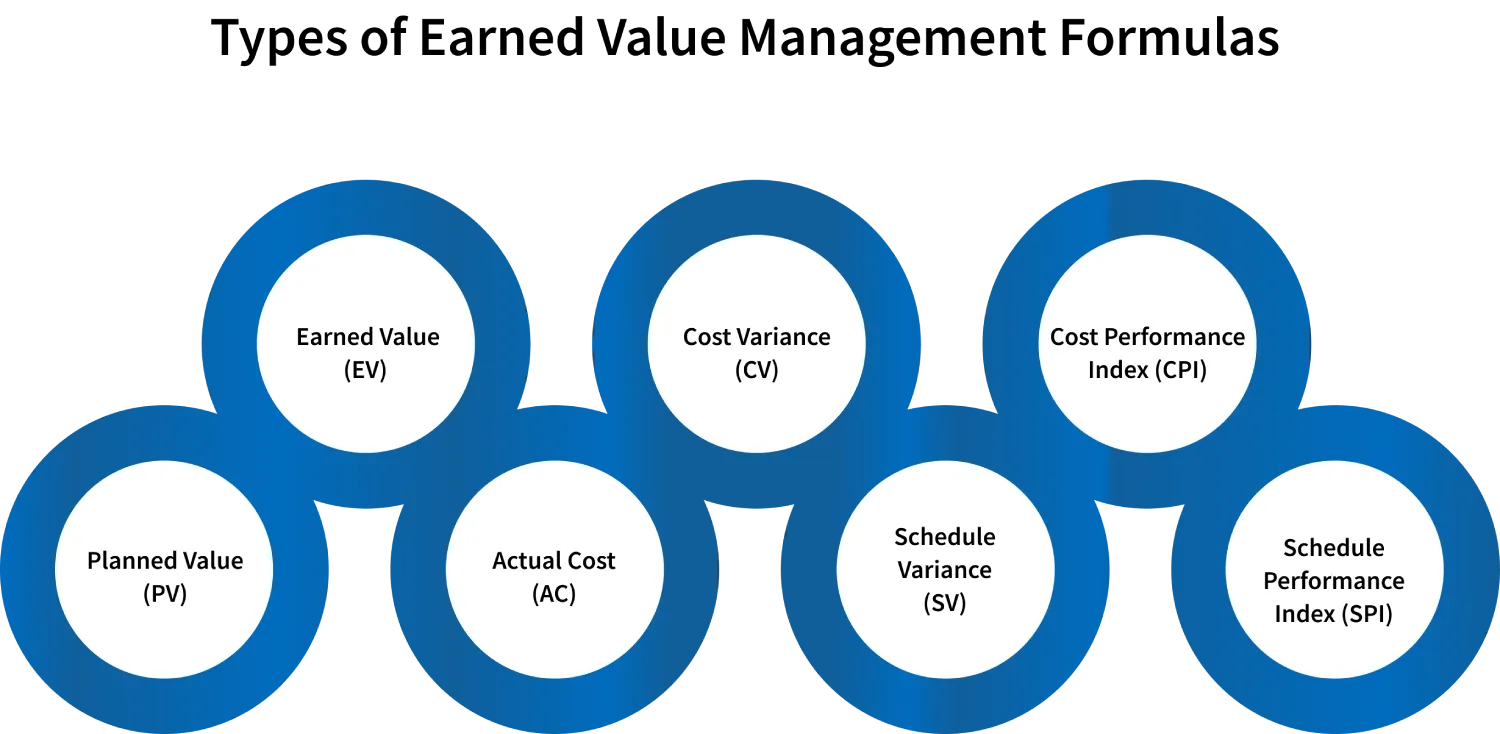
To keep your project on track with costs, timelines, and progress, it’s important to understand the main earned value management formulas. They give you a clear picture of how your project is really doing and help you make smarter, timely decisions. Here are the 7 different types of earned value management formulas:
1. Planned Value (PV)
2. Earned Value (EV)
3. Actual Cost (AC)
4. Cost Variance (CV)
5. Schedule Variance (SV)
6. Cost Performance Index (CPI)
7. Schedule Performance Index (SPI)
1. Planned Value (PV)
Planned Value is used to show the amount of work that should have been completed by now based on your original project plan. It helps you see whether you are on schedule and within your budget. Once you begin working with earned value management formulas, PV becomes the baseline for every comparison you make in earned value analysis.
Planned Value Formula
PV = Planned % of Work × Budget at Completion (BAC)
Let's break it down. Suppose you intended to complete 40% of the project by the end of this week, and you had a total budget of $1,000,000, the PV would be $400,000. This figure shows you what your progress should be at this time. You use this to measure how far ahead or behind you are when calculating EVM.
2. Earned Value (EV)
Earned Value shows the actual value of the work completed so far based on your original budget. Instead of guessing how much progress has been made, this earned value formula gives you a number that represents actual work done. It is one of the most important earned value management calculations because it connects progress with money.
Earned Value Formula
EV = Actual % of Work Completed × Budget at Completion (BAC)
Once you know how to calculate earned value correctly, you see your true progress without assumptions. Assuming that you have already accomplished 30% of the project and your total budget is $1,000,000, your EV is $300,000. This BCWP(Budgeted Cost of Work Performed) is simply another name for earned value that many people in project management still use. You will use this number repeatedly in EVM formulas such as CV, SV, CPI, and SPI.
3. Actual Cost (AC)
Actual Cost demonstrates how much money you have already spent on the work done so far. It is simple but powerful. You record all the expenses, such as labour, materials, tools, and other expenses. This figure helps you understand the true cost of progress and is essential when you calculate earned values.
Actual Cost Formula
EV = Actual % of Work Completed × Budget at Completion (BAC)
As an example, say you planned to spend $300,000 but ended up spending $340,000 on the same work, AC will reveal the difference clearly. When you contrast AC with EV, then you immediately know whether you are spending healthily or you are drifting. This is the basis for cost variance and many other earned value management formulas.
4. Cost Variance (CV)
Cost Variance shows you whether you are spending more or less than you had planned. It gives you a quick and honest view of cost performance. With the help of this earned value equation, you instantly know if your budget is safe or slipping.
Cost Variance Formula
CV = EV − AC
When the CV is positive, then you are under budget. When it is negative, then you are overspending. You have an EV of $400,000 and an AC of $360,000. Your CV is +$40,000, which means you saved money while completing the planned work. It makes Cost Variance one of the most useful earned value formulas that are useful in identifying any cost problems at the beginning.
5. Schedule Variance (SV)
Schedule Variance assists you in knowing whether you are behind schedule or ahead. You do not check by intuition with timelines, but instead use an earned value calculation that shows what’s really happening. It allows you to see at a glance whether your project is on track or is lagging.
Schedule Variance Formula
SV = EV − PV
When SV is positive, then you are ahead of schedule. When it is less than zero, you are lagging behind. Take the case when your EV is $300,000 and your PV was $400,000, then you are behind by $100,000 of planned work. This equation will make you observe actual schedule performance, and not time elapsed. It is necessary in case you want to understand how to calculate earned value analysis properly.
6. Cost Performance Index (CPI)
CPI tells you how efficiently you are using your budget. It answers the question: Are you getting the most for every dollar you spend? This is one of the key EVM formulas for predicting future project costs.
CPI Formula
CPI = EV ÷ AC
If CPI is above 1, you are using your budget efficiently. If it is below 1, you are paying too much for the work completed. For example, if your EV is $500,000 and your AC is $600,000, your CPI becomes 0.83, which means your spending efficiency needs attention. CPI is also used in estimate at completion formula (EAC) in project management.
7. Schedule Performance Index (SPI)
SPI displays your schedule efficiency. It tells you how quickly or slowly you are progressing compared to your planned timeline. When you learn how to calculate earned value management properly, SPI becomes one of the most reliable indicators of schedule health.
SPI Formula
SPI = EV ÷ PV
When SPI exceeds 1, then you are ahead of schedule. When this is less than 1, progress becomes slower than planned. Suppose that your EV is $400,000 and your PV is $500,000. Your SPI is 0.8, that is, you are not moving as fast as expected. This is a common SPI formula in PMP and project management since it displays the actual pace of your project.
Conclusion
Once you understand earned value management formulas, you can see exactly where your project stands without guessing. You’ll be able to compare what you planned with what you’ve actually done, keep track of costs, and see your progress clearly. These EVM formulas guide you to make smarter decisions, spot risks early, and keep your project on track.
By understanding EVM and using formulas like cost variance, schedule variance, estimate at completion, and the estimate to complete formula, you stay in control and ensure your project moves forward with confidence and clarity.
FAQs
Earned value management formulas are simple calculations that show you how your project is really doing. They compare what you planned, what you’ve actually completed, and what you’ve spent, giving you a clear picture of progress, costs, and overall performance.
Earned value analysis lets you see the true status of your project by connecting costs, timelines, and progress. It helps you spot problems early so you can adjust plans, use resources wisely, and make confident, informed decisions.
Earned value is calculated by multiplying the percentage of work you’ve actually completed by the total project budget. It shows the real value of work done and forms the basis for other important calculations like CV, SV, CPI, and SPI.
Cost variance indicates if your project is costing more or less than planned, while schedule variance shows whether you’re ahead or behind schedule. Together, they give a clear picture of project health and help you take timely corrective action.
Get a demo of BIXO

Recommended Blogs

How to Delegate Tasks Effectively: 7 Tips for Managers
Learn how to delegate tasks effectively, save time, and boost team productivity with step-by-step tips, real examples, and smart AI tools.
 Bhuvana Bitra |
 Oct 17, 2025

Project Objectives: A Simple Guide with Real Life Examples
Learn how to set clear project objectives that guide your team, track progress, and ensure success. Get practical tips and real-life examples to get started right.
Tarun Kumar Reddy Atmakuru |
Oct 17, 2025

25 Key Project Management Skills Every Manager Should Master
Learn 25 essential project management skills - soft, hard, and technical to manage teams, meet deadlines, and deliver successful projects.
Tarun Kumar Reddy Atmakuru |
Oct 17, 2025
×
Focus on what matters. BIXO handles the rest!